

 login
login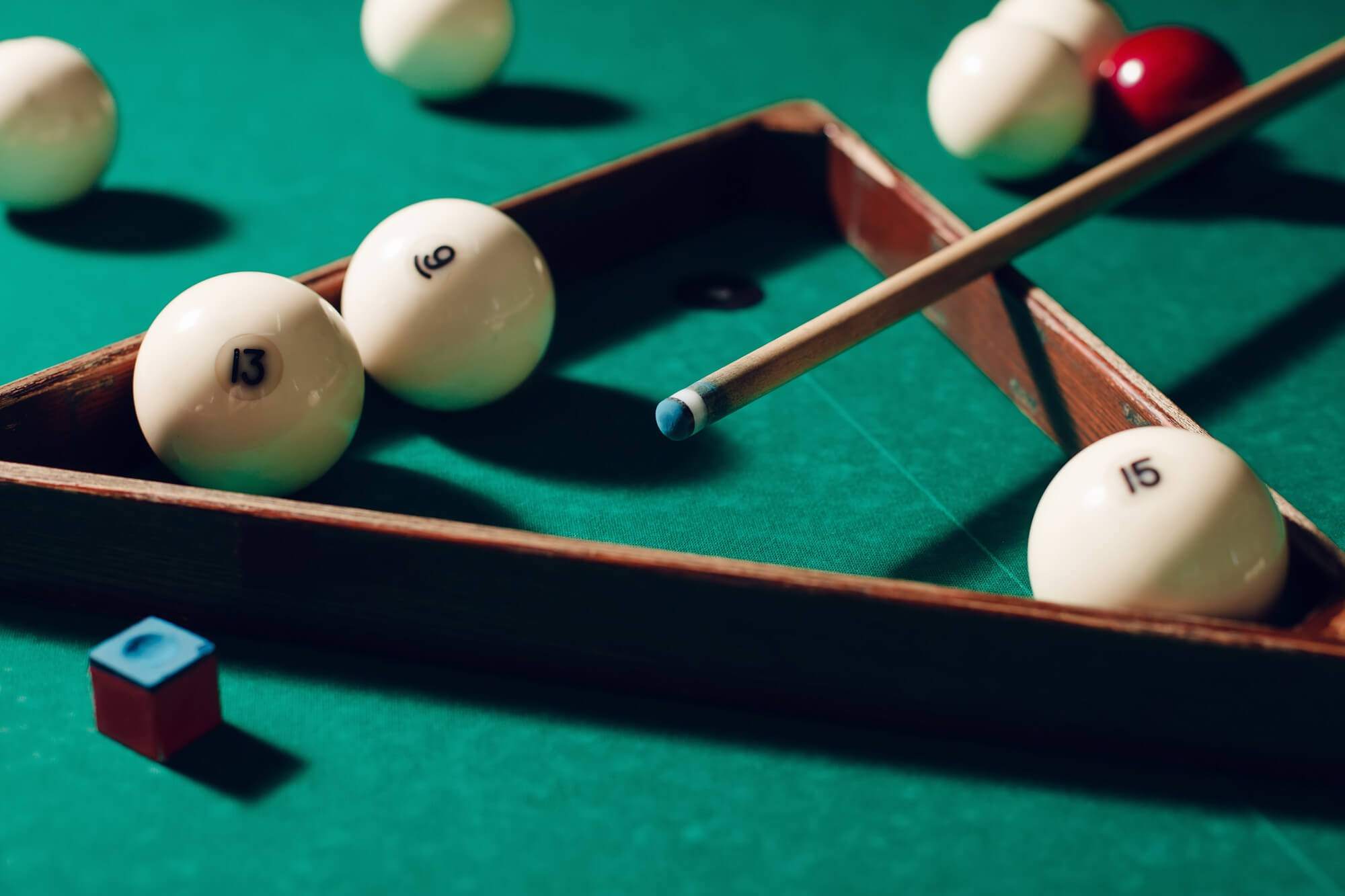
1. Billiard Equipment and Accessories
When playing any of the Pyramid disciplines described below, billiard tables, balls, and accessories must comply with the Technical Requirements for Billiard Equipment.
2. Billiard Table Markings
2.1 The playing surface of the billiard table must clearly and accurately display the following lines and markings:
- Center Spot – a point located at the center of the playing surface.
- Center Line – a straight line passing through the center spot, parallel to the short rails. It divides the table into a front half and a back half.
- Front Spot – a point located at the center of the front half of the playing surface.
- Baulk Line (Home Line) – a straight line passing through the front spot, parallel to the front rail.
- Back Spot – a point located at the center of the back half of the playing surface.
- Spotting Line – a portion of the table’s longitudinal line extending from the back spot to the middle of the back rail.
- Temporary Baulk Line (used in Combined Pyramid) – a straight line passing through the back spot, parallel to the back rail.
2.2 Baulk (Home) is the area of the playing surface bounded by the baulk line and the front rail.
3. Balls Used
The standard set consists of sixteen Pyramid billiard balls:
- Fifteen white (ivory-colored) balls numbered 1 through 15;
- One colored (preferably yellow), unnumbered ball.
4. Cue Ball and Object Balls
4.1 The cue ball is the ball struck with the cue during play.
4.2 All other balls on the playing surface, except the cue ball, are object balls.
5. Cue Strike on the Cue Ball
5.1 The cue ball must be struck only with the cue tip and along the longitudinal axis of the cue. Any violation results in a foul.
5.2 At least one foot of the player must be in contact with the floor at the moment of striking the cue ball. Otherwise, a foul is assessed.
6. Contact Between Cue Ball and Object Ball
6.1 Contact (collision) between the cue ball and at least one object ball, resulting in the transfer of motion, is a mandatory requirement for any legal stroke.
6.2 If the cue ball fails to contact any object ball, a foul is committed.
6.3 The cue ball may strike an object ball directly or after contacting one or more rails.
6.4 A stroke directed away from a touching object ball, without transferring motion to it, does not constitute legal contact. If no other object ball is contacted afterward, a foul is assessed.
7. Order of Play
7.1 If a ball is legally pocketed, the player continues their turn.
7.2 If no ball is pocketed on a legal stroke, the turn passes to the opponent.
7.3 Playing out of turn is a foul.
7.4 If a foul is committed, the opponent, after respotting incorrectly pocketed and jumped balls and removing the penalty ball, may:
- take the next shot themselves; or
- require the offending player to take the next shot.
8. Determining the Break (Lag for Break)
8.1 Players stand on opposite sides of the table’s longitudinal line and simultaneously play a ball-in-hand shot from baulk toward the back rail and back.
The player whose ball comes to rest closer to the front rail wins.
8.2 The lag is automatically lost if the ball:
- crosses into the opponent’s half;
- fails to reach the back rail;
- is pocketed;
- jumps off the table;
- contacts a long rail;
- contacts the back rail more than once.
8.3 If both players violate the rules or the referee cannot determine the winner, the lag is repeated.
8.4 The winner of the lag may:
- take the break shot; or
- pass the break to the opponent.
9. Initial Rack
9.1 Before the break shot, the fifteen white balls are racked in an equilateral triangle (pyramid) with the apex on the back spot and the base parallel to the back rail.
All balls must be in full contact with adjacent balls. A standard triangle rack must be used.
9.2 The colored ball, used as the cue ball for the break shot, is placed in baulk.
9.3 Situations may arise requiring the formation of an incomplete pyramid. All requirements for a full rack apply, with the following differences:
- Balls are filled from the apex toward the base;
- The base row is filled symmetrically from the center outward;
- If necessary, a ball from the apex may be moved to achieve symmetry.
10. Ball Position
The position of a ball is determined by the location of its center.
11. Baulk and Baulk Line
11.1 The baulk line is not part of the baulk.
11.2 A ball resting on the baulk line is considered outside the baulk.
12. Putting the Cue Ball into Play (Start of Play)
12.1 The cue ball is put into play by a break shot played from baulk.
12.2 The colored ball must always be used as the cue ball for the break.
12.3 The opening player may place the cue ball anywhere within baulk, but not on the baulk line.
If the cue ball is improperly placed, the referee or opponent may warn the player before the shot. Otherwise, the placement is considered legal.
12.4 The cue ball is considered in play immediately upon being struck by the cue tip.
12.5 Until the cue ball is struck, it may be adjusted by hand or cue; once placed, any contact constitutes putting it into play.
13. Legal Break Shot
13.1 The break is legal if, after cue ball contact with an object ball:
- a ball is legally pocketed; or
- at least three different object balls contact one or more rails; or
- two different object balls contact a rail and at least one object ball crosses the center line.
Otherwise, a foul is assessed.
13.2 If the break is illegal, the opponent, after removing a penalty ball, may:
- accept the position and continue play;
- accept the position and require the offender to shoot;
- re-rack and break themselves;
- re-rack and require the offender to break.
Note: Re-racking follows incomplete pyramid rules (see §9.3).
14. Alternation of Breaks
14.1 In subsequent games, players alternate breaks.
14.2 Both players are responsible for ensuring the correct order of play.
15. Start and Completion of a Stroke
15.1 A stroke begins when the cue tip contacts the cue ball and ends when all balls have come to rest.
(A ball spinning in place is considered in motion.)
15.2 Shooting before the completion of the previous stroke is a foul.
16. Touching Balls
Except for striking the cue ball with the cue tip and placing the cue ball before it is in play, touching any ball with the cue, bridge, chalk, hand, clothing, or any object is prohibited and constitutes a foul.
17. Double Hit
If the cue tip contacts the cue ball more than once in a single stroke, it is a double hit and a foul.
18. Push Shot
A prolonged contact between the cue tip and cue ball, resulting in the cue ball following the object ball, is a push shot and a foul.
19. Touching and Close Balls
19.1 If the cue ball is touching or extremely close to an object ball, the stroke is legal provided it is executed:
- at an angle of at least 45 degrees away from the line of centers; or
- without forward motion of the cue ball following the object ball.
Otherwise, a foul is assessed.
19.2 If no double hit or triple contact occurs, forward motion alone does not constitute a foul.
20. Legal Completion of a Stroke
Any stroke (except the break) is legal if no rules are violated and, after contact with an object ball, at least one ball:
- is pocketed; or
- contacts a rail and meets additional rail/ball contact criteria; or
- crosses the center line and meets subsequent contact criteria.
Failure to meet any condition results in a foul.
21. Legally and Illegally Pocketed Balls
21.1 A ball is legally pocketed if it falls into a pocket as a result of a legal stroke.
21.2 All legally pocketed balls are removed from the pockets and placed on the player’s scoring shelf.
21.3 If a foul occurs during a stroke, all balls pocketed on that stroke are considered illegally pocketed.
21.4 Illegally pocketed balls are not counted and must be respotted immediately.
21.5 A ball that rebounds from a pocket back onto the table is considered not pocketed.
22. Hanging Ball
22.1 If a hanging ball falls without external influence and does not affect the stroke outcome, it is restored.
22.2 If it affects the stroke outcome, all balls are restored and the stroke is replayed.
22.3 If a moving ball comes to rest momentarily and then falls, it is considered pocketed as a result of the stroke.
23. Jumped Ball
23.1 A ball is considered jumped if it comes to rest off the playing surface.
23.2 A ball that returns to the table without contacting external objects is not considered jumped.
23.3 Any jumped ball results in a foul.
23.4 All jumped balls are respotted after the stroke.
24. Miscue
24.1 A miscue is defined as slipping of the cue tip on the cue ball.
24.2 A miscue without additional violations is not penalized.
25. Spotting Balls
25.1 All illegally pocketed and jumped balls are respotted before the next stroke.
25.2 Balls are spotted on the back spot or along the spotting line, according to availability and order.
Note:
- In Free Pyramid, cue balls and object balls are spotted equally.
- In Combined, Dynamic, and Classic Pyramid, only object balls are spotted; the cue ball is returned according to discipline-specific rules.
26. Outside Interference
26.1 If balls move due to external interference, positions are restored and play continues without penalty.
26.2 If restoration is impossible, balls are re-racked and play resumes with the break procedure. The score remains unchanged.
27. Fouls
27.1 Fouls are assessed for all listed violations, including improper cueing, no contact, illegal break, double hit, push shot, jumped ball, and others.
27.2 Multiple fouls on a single stroke result in only one penalty.